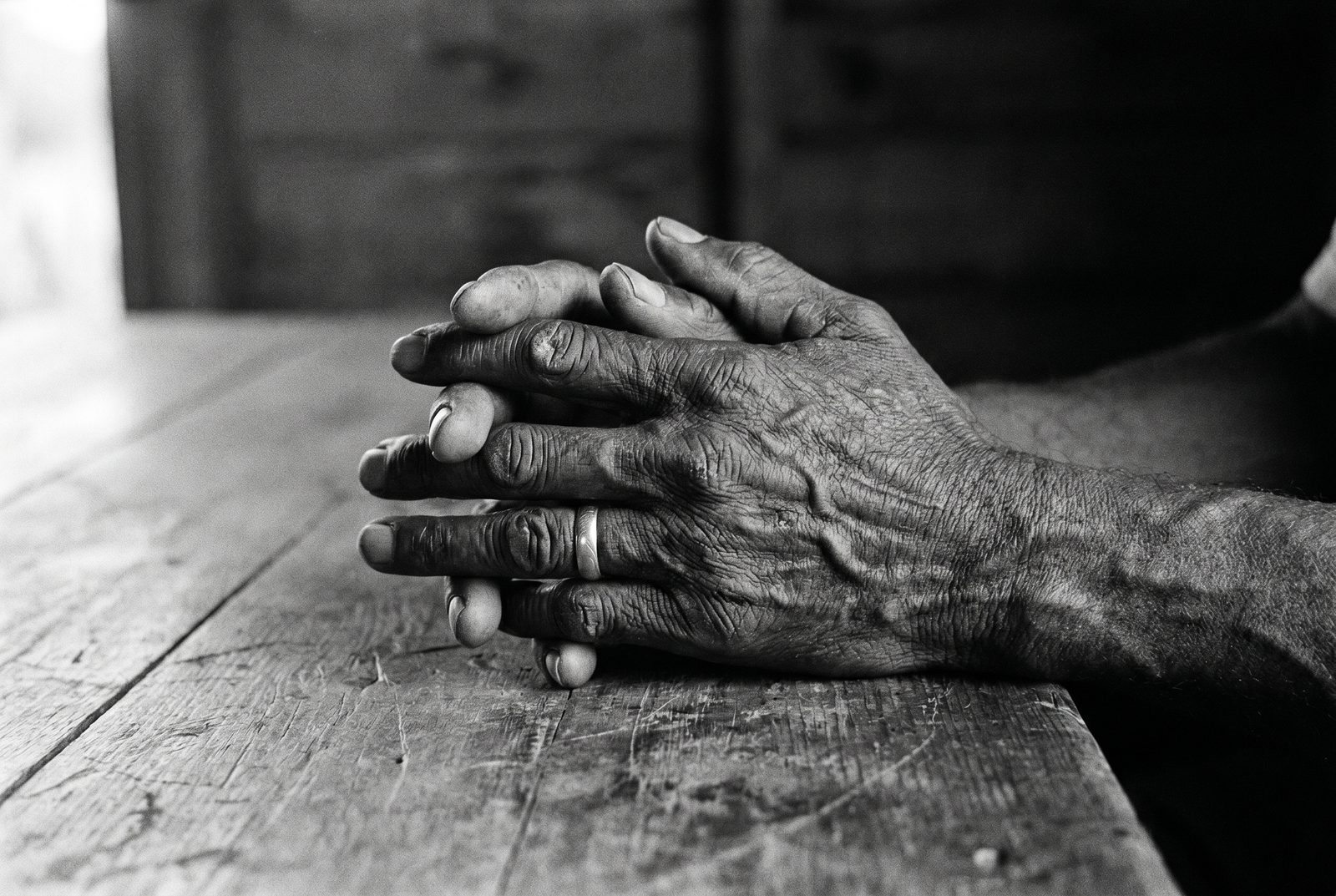
Your grandfather lowered his eyes when the sheriff drove by. You don't remember that. But your nervous system does.
When the cop pulls behind you on the highway and your shoulders rise to your ears before you have thought a thought — that is not anxiety. That is inheritance. That is the body of a man you never met, still operating inside your spine. You are walking around in armor your grandfather welded in 1955 and his grandfather welded in 1885. You did not put it on. You do not know how to take it off. And every time someone asks why you are so guarded, so distant, so "difficult," you do not have words — because the armor is older than your language.
This is the cost of the cape. This essay is about what it costs to wear it, and what it would cost to finally, carefully, set it down.
Trauma is inherited through nervous systems, not just through stories
For most of the twentieth century, we thought trauma was a story problem. You experienced something terrible, you told yourself a story about it, the story shaped your behavior. Treatment was about updating the story.
That model is incomplete.
Trauma also lives in the body. Specifically, in the autonomic nervous system — the system that controls how quickly your heart races, how shallow your breath becomes, how tightly your shoulders rise, how quickly you can read whether a room is safe.
A baby raised by a hypervigilant caregiver learns hypervigilance before they learn language. The mother whose own grandmother lived through Jim Crow scans every room she walks into. The baby in her arms scans with her. By the time the baby is two, the scanning has become his baseline. By the time he is forty, he does not know he is scanning. He thinks the world really is that dangerous.
This is what Resmaa Menakem calls somatic abolitionism — the long, careful work of unlearning the body's inheritance.
Why talk therapy alone often fails Black men
If trauma is a body problem and we treat it like a story problem, the body keeps casting the same vote.
Many of the Black men who have tried traditional talk therapy and given up tell a version of the same story: I told her everything and nothing changed. I understood my pattern. I could narrate it intelligently. I still woke up at 3 a.m. with my fists clenched.
This is not a failure of insight. It is a misdiagnosis. The man's intellect updated. His nervous system did not.
Modalities that work directly with the body — EMDR, Somatic Experiencing, Internal Family Systems with somatic components, the polyvagal-informed work pioneered by Stephen Porges — are designed to update the nervous system's predictions, not just the patient's understanding. They are slower. They are more relational. They look strange from the outside. And for many Black men, they are what finally helps.
Naming the lineage
There is a step that talk therapy often skips that I want to put back on the table here.
Before you ask the armor to soften, you have to honor what it was for.
Your grandfather did not survive Jim Crow because he was tough. He survived because his body learned to scan and contract and lower his eyes at the right moments. The armor saved his life. He passed it to your father. Your father passed it to you. Three generations of survival are inside your spine.
You cannot shame this armor into leaving. You cannot reason it away. What you can do is acknowledge it.
"The men in my family survived something I did not have to survive. I am here because they wore this. I am going to set it down — carefully, slowly — so the next generation does not have to wear it as heavy."
That sentence, spoken out loud, does work that no insight alone can do. It addresses the right party. It thanks them. It makes the release a continuation of their work rather than a betrayal of it.
What you can do this week
- The lineage acknowledgment. Once this week, speak to your grandfather (or great-grandfather, or any ancestor whose name you know) out loud or in a journal. Thank him for the armor. Tell him you are going to begin setting it down.
- The somatic check-in. Three times a day for a week, pause for ten seconds. Where are your shoulders? Where is your jaw? Is your breath shallow? When you notice tension, do not fix it — just name it as inheritance. This is older than me. This is not personal.
- A release ritual. Ten minutes once a week. Breathe slowly. Shake out your hands and arms. Press your feet into the floor and feel the ground. You are telling your nervous system, in the only language it speaks, that the threat is a generation old.
Your grandfather did not survive Jim Crow so you could die of a stress-induced heart attack at fifty-two. You are allowed to put it down. Carefully. With gratitude. But down.